
CASE STUDY · PLATFORM PARTNERSHIP

A Fully Remote Study of a Drug-Free Self-Massage Tool for Stress and Tension
Study Overview
Army veteran Joe Meisch spent years collecting letters from service members, clinicians and first responders who used his Temple Massager, a hand-held, non-electric tool for the temples and jaw. In 2026 his company commissioned its first formal study to see what a structured, registered evaluation would show.
MOQ Collective designed and ran the study as the clinical research partner, using People Science's Chloe® platform and participant community. Over four weeks of daily home use, 35 evaluable participants, mostly midlife women with frequent headaches and jaw clenching, reported a large reduction in anxiety symptoms and improvements in 7 of 8 wellbeing domains, with no adverse events.
Who Did What
A small, veteran-founded brand, an evidence-to-market research partner, and a decentralized research platform, each in its own role.

Sponsor
- Commissioned and funded the study
- Supplied the product to every participant
- Service-Disabled Veteran-Owned Small Business, Cazadero, California
Joe Meisch, inventor and CEO
Clinical Research Partner
- Study design and protocol (MOQ-TM-2026-01)
- IRB approval and trial registration
- Study management, analysis and clinical summary
Colleen Quinn, principal investigator · Megan Morris, managing director

Research Platform
- Chloe® platform: eligibility, e-consent, daily diaries, surveys and reminders
- Recruitment from the People Science participant community
- Fully remote data capture from home
Licensed by MOQ Collective to run the study
Quick Study Snapshot
Study Type
Single-arm, open-label, observational; fully remote
Duration
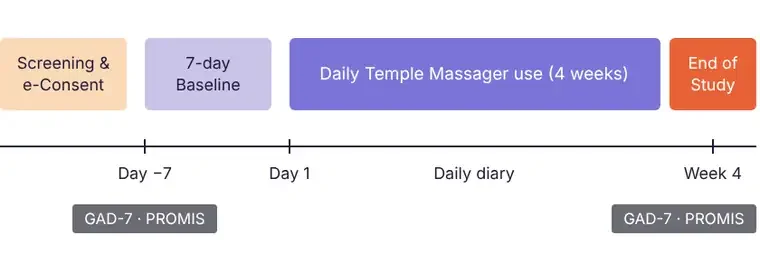
7-day baseline + 4 weeks of daily home use (June–July 2026)
Participants
68 enrolled; 57 completed; 35 evaluable
Population
Adults 36–65 (mean 48.2), mostly women; 97% jaw clenching, 89% five or more headache days a month
Primary Focus
Anxiety symptoms (GAD-7)
Secondary Measures
PROMIS-29, PROMIS Sleep Disturbance 8a, headache days, over-the-counter medication use
Oversight
Sterling IRB; ClinicalTrials.gov NCT07639658
Delivery Method
Chloe® Clinical Research Platform
Sponsor · Research Partner · Platform
Temple Massager · MOQ Collective · People Science
Key Findings
−4.80
Points on the GAD-7 Anxiety Scale (9.91 → 5.11; p<0.001), above the 4-point clinically meaningful threshold
30/35
Participants Improved on the Primary Outcome
7 of 8
Wellbeing Domains Improved (PROMIS-29 and Sleep 8a); physical function, the control, did not change
−57%
Days a Week With Over-the-Counter Pain Medication (1.66 → 0.71)
0
Adverse Events Across 286 Assessments

See the Registered Study
The protocol and outcomes were specified before the study started and recorded on ClinicalTrials.gov. The study is described in full in MOQ Collective's clinical summary.
NCT07639658 · Sterling IRB 16370 · Protocol MOQ-TM-2026-01 v02
Study Details
Study Design
Objective
Describe changes in anxiety symptoms and wellbeing among adults using the Temple Massager daily for four weeks.
Design
Single-arm, open-label, observational study with pre-specified outcomes. Approved by Sterling IRB and registered as NCT07639658.
Intervention
Daily self-massage of the temples and jaw with the Temple Massager, a patented, hand-held, non-electric tool made in the United States.
Data Collection
GAD-7, PROMIS-29 and PROMIS Sleep Disturbance 8a at baseline and end of study, plus daily diaries of use, headache days and medication in the Chloe app.
How It Ran on Chloe
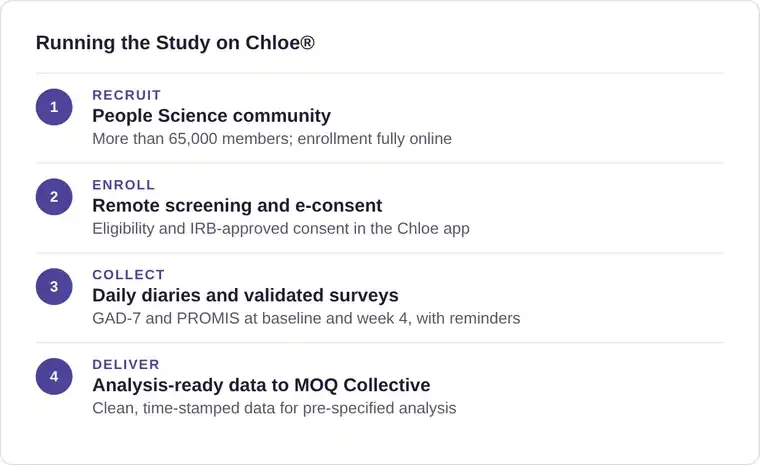
MOQ Collective licensed the Chloe® platform to run the study end to end, without building its own technology or recruiting through clinics. Participants took part from home, on their phones, in their normal routines.
Recruit: eligible participants came from the People Science community of more than 65,000 people. Enrollment filled in under 12 hours.
Enroll: eligibility questions and IRB-approved e-consent in the Chloe app.
Collect: daily diaries of use, headaches and medication, plus GAD-7 and PROMIS at baseline and week 4, with reminders built in.
Deliver: clean, time-stamped data handed to MOQ Collective for pre-specified analysis.
Participant Demographics
Participants
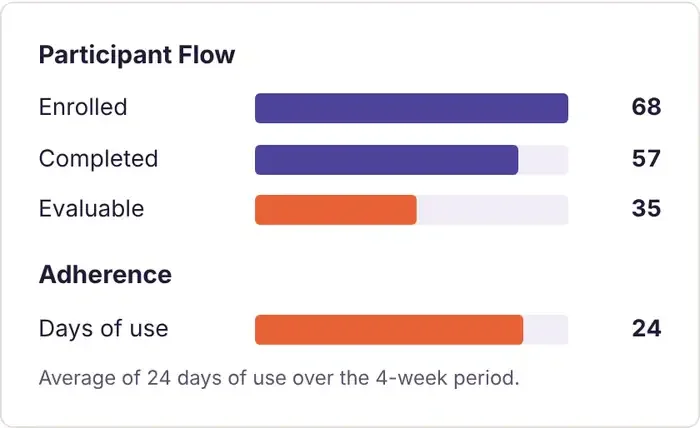
68 enrolled, 57 completed, 35 evaluable for the primary analysis
Age
36–65; mean 48.2
Health Profile
97% reported jaw clenching or TMJ symptoms and 89% had five or more headache days a month. 69% were peri-, post- or surgically menopausal. Mean baseline GAD-7 was 9.91, in the mild-to-moderate range.
Adherence
Average of 24 days of use over the 4-week period
Recruitment
People Science participant community; participation entirely from home




Outcome
Anxiety: GAD-7 scores fell from 9.91 to 5.11 (mean change 4.80; 95% CI 3.47–6.13; p<0.001; Cohen's dz 1.24), about 2.5 times the effect the study was powered to detect.
Robust across analyses: the result held in the evaluable (n=35), complete-case (n=50) and baseline-carried-forward (n=61) populations, all p<0.001, and was independently reproduced.
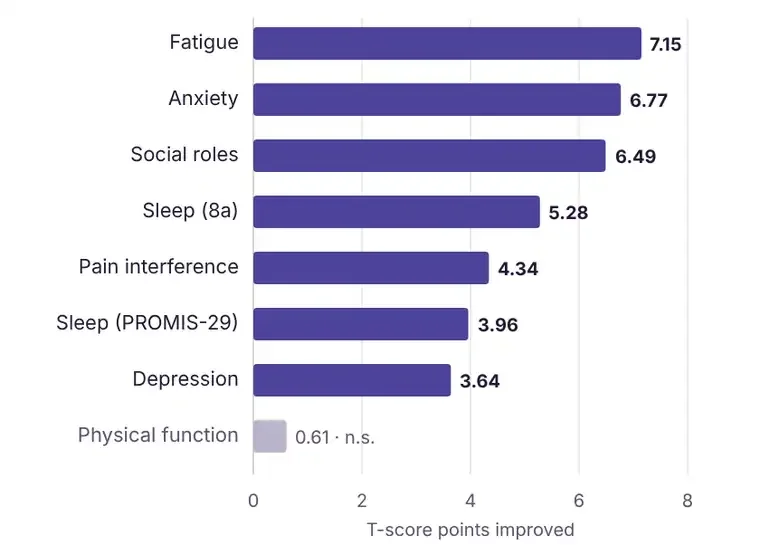
Wellbeing: 7 of 8 PROMIS domains improved, led by fatigue, anxiety and social roles. Physical function, which the tool would not be expected to change, stayed flat.
Headaches and medication: headache days fell from 4.4 to about 3.0 a week (28 of 34 improved), and days with over-the-counter pain medication fell from 1.66 to 0.71 a week. Headache intensity did not change.
Safety: no adverse events across 286 assessments and 169 free-text responses.
In Their Words
SponsorI know what it feels like when the stress and tension build up and you just need some relief. Now we have research behind what I've been hearing from people for years, and I want to use that momentum to get this into the hands of people doing some of the most stressful jobs out there.
Joe MeischInventor and CEO, Meisch Temple Massager, Inc.
Research PartnerWomen's health has waited too long for evidence, and small, mission-driven brands are too often priced out of producing it. Temple Massager's study shows that does not have to be the case.
Colleen QuinnPrincipal Investigator, MOQ Collective
PlatformWe built Chloe so research partners like MOQ can bring rigorous, decentralized research to brands of every size, including those a traditional trial would price out.
Paige OliverHead of Product, People Science
From Field Letters to Registered Data
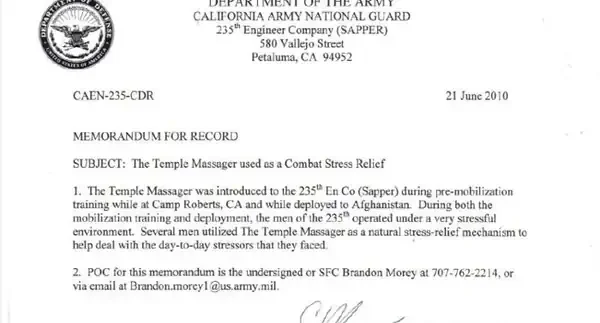
The Temple Massager was introduced to soldiers of the California Army National Guard during pre-mobilization training and deployment to Afghanistan, and endorsements from units, psychologists and the Department of Veterans Affairs followed over the next decade.
Letters build trust but are not evidence. The study turned those reports into pre-specified, IRB-approved, registered data that the brand can share with buyers, clinicians and the people it serves.
What the Study Shows
-
Participants reported a large, clinically meaningful drop in anxiety symptoms over four weeks of use.
Improvement in 7 of 8 wellbeing domains, with the control domain (physical function) unchanged.
No adverse events across 286 assessments.
High adherence in a fully remote study: an average of 24 days of use over 4 weeks.
-
That the device caused the changes; the study had no control group.
How much of the change is due to the device rather than regression to the mean or expectation.
The size of the headache effect, because the diary format changed mid-study.
Whether results generalize beyond this mostly female, midlife group.
Additional Information
-
ClinicalTrials.gov: NCT07639658
IRB: Sterling IRB, 16370 · Protocol MOQ-TM-2026-01, version 02
Measures: GAD-7; PROMIS-29; PROMIS Sleep Disturbance 8a
-
MOQ Collective is an evidence-to-market partner for wellness brands, combining clinical trial design and management, regulatory strategy and scientific storytelling to help brands prove that their products work. moqcollective.com
Meisch Temple Massager, Inc. is a certified Service-Disabled Veteran-Owned Small Business based in Cazadero, California, and maker of the patented Temple Massager, a hand-held, non-electric self-massage tool made in the United States. templemassager.com
-
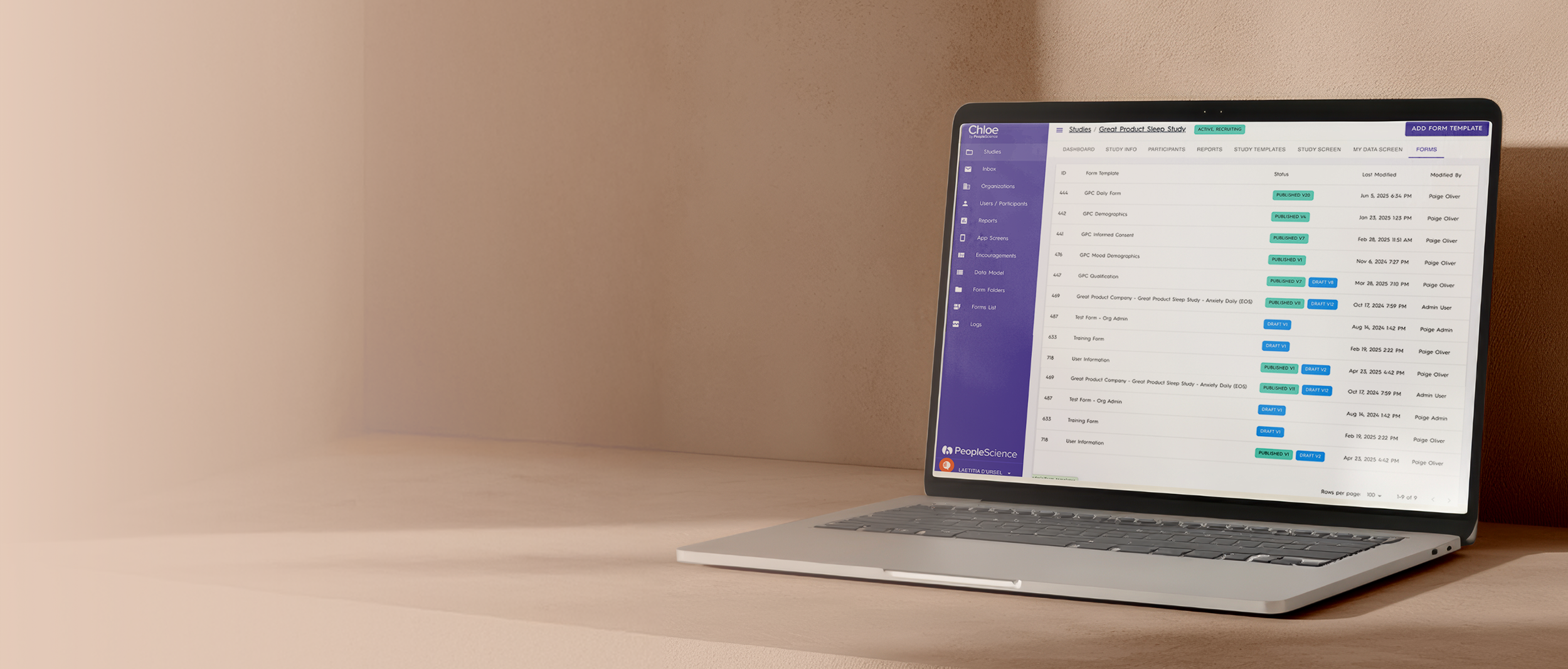
Chloe® (Consumer Health Learning & Organizing Ecosystem) combines a participant mobile app with a research platform for decentralized studies, covering eligibility, consent, randomization, daily data entry, reminders and monitoring from home.
Brands run studies with People Science directly, and research partners such as CROs license Chloe to run their own.
FAQ
-
Adults who used the Temple Massager daily for four weeks reported a large drop in anxiety symptoms on the GAD-7, plus improvements in fatigue, sleep, social participation, pain interference and mood. No adverse events were reported.
-
No. It was a single-arm, open-label observational study. A controlled trial would be needed to show how much of the change is caused by the device.
-
MOQ Collective designed and managed the study and analyzed the data, with Colleen Quinn as principal investigator. Temple Massager sponsored it. People Science provided the Chloe® platform and recruited participants from its community.
-
No adverse events were reported across 286 safety assessments, and 169 free-text responses were reviewed.
-
No. The Temple Massager is a general wellness product and is not a medical device. It is not intended to diagnose, treat, cure or prevent any disease.
-
Adults aged 36–65, mostly women, with frequent headaches and jaw clenching and mild-to-moderate anxiety symptoms at baseline. 68 enrolled and 35 were evaluable for the primary analysis.
The Temple Massager is a general wellness product and is not a medical device. It is not intended to diagnose, treat, cure or prevent any disease. The study describes self-reported changes among participants using the device; it does not establish that the device alone caused those changes. Individual results vary.
Other Case Studies


Run Your Studies on Chloe
For CROs and research partners: license Chloe to run fully remote studies, with access to a community of more than 65,000 participants.